

Two comic strips. Same patient. Two very different healthcare experiences.
In the first comic strip, the story is painfully familiar to anyone who has worked in healthcare. A patient has waited months for an appointment. The care team is ready to help. Everyone assumes the needed records have been sent. Then the fax arrives incomplete—only a few pages out of many. The office has to request the records again, wait again, and eventually tell the patient the appointment has to be rescheduled.
It is frustrating for the healthcare worker, who is trying to do the right thing with the tools available. It is even more frustrating for the patient, who took time off work, waited for care, and now has to start over because information did not move the way it needed to move.
The Fax Machine Is Funny Until It Delays Care
It is easy to make faxing the joke. The beeping. The busy signals. The disconnected numbers. The mystery of whether all pages actually arrived. Healthcare workers laugh because they recognize the absurdity of relying on an old communication method in a modern clinical environment.
But the punchline stops being funny when the delay lands on a patient. Behind every incomplete fax is a person waiting for an answer, a treatment plan, a specialist visit, a clearance, a referral, or peace of mind. Behind every duplicate request is a staff member pulled away from direct patient support to chase paperwork that should already be available.
That is what the first comic strip captures so well. Faxing is not just an outdated technology problem. It is a workflow problem. It is a staffing problem. It is a patient experience problem. And in some moments, it becomes a care coordination problem.
Same Situation, Different Workflow
The second comic strip tells the same story with a different ending. The patient still needs records. The healthcare worker still has a job to do. The difference is that instead of sending another fax and hoping the missing pages arrive, the care team uses Centralis Health’s Health Information Exchange to look for the records directly.
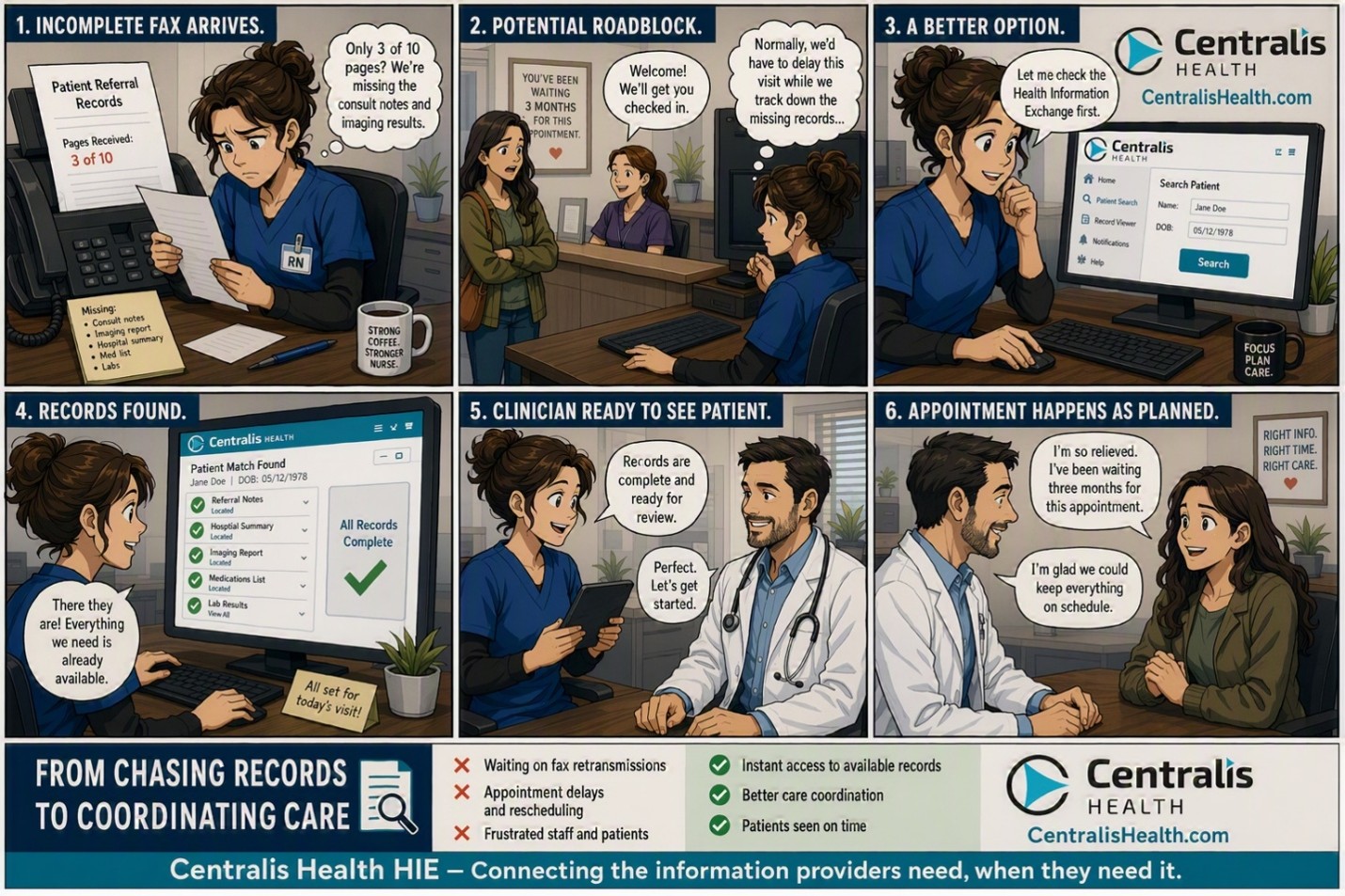
That small change matters. Instead of waiting on a second transmission, calling another office, refaxing a request, or rescheduling a patient who has already waited long enough, the care team has a better path forward. Records can be located more efficiently. Staff can spend less time chasing documentation. The patient has a better chance of keeping the appointment and receiving care when it was originally planned.
Centralis Health cannot make every fax problem disappear overnight. Healthcare still depends on faxing in many places, and that reality is not going away anytime soon. But we can give healthcare organizations tools that make the process less painful, less manual, and less dependent on hope.
Interoperability Has to Work in the Real World
When we talk about interoperability, it can sound technical. We talk about systems, connections, portals, networks, data sharing, and exchange standards. All of that matters. But at the operational level, interoperability is much more practical.
It means a referral coordinator does not have to wonder whether the right pages came through. It means a nurse is not left apologizing for a delay she did not create. It means a provider has more complete information before making decisions. It means a patient does not have to take another day off work because records were trapped in a broken process.
That is why Health Information Exchange matters. It helps move healthcare communication beyond isolated transactions and toward a more connected workflow. Instead of relying only on a faxed document to represent a patient’s story, HIE gives care teams another way to access the information they need, when they need it.
Faxing Is a Symptom, Not the Whole Disease
Faxing is often treated like the villain in healthcare technology conversations, but it is usually more complicated than that. Faxing continues because healthcare is fragmented. Not every system connects cleanly. Not every organization has the same tools. Not every workflow is built around digital exchange. In that environment, fax becomes the fallback.
The problem is that fallback workflows become permanent workflows when they are not challenged. A single failed fax may feel like a small inconvenience. A missing page may feel routine. A rescheduled appointment may feel unavoidable. But when those moments happen across hundreds of practices, hospitals, specialists, and patients, the burden becomes enormous.
The comic strips make the issue easy to see. One workflow creates more waiting, more apologizing, and more frustration. The other gives the care team a better option.
Better Tools Create Better Moments
Healthcare workers do not need more complicated processes. They need tools that fit the way care actually happens. They need ways to locate records, communicate securely, reduce duplicate work, and keep patient care moving even when traditional fax workflows fall short.
At Centralis Health, we know we cannot fix every problem with faxing. But we can help healthcare providers reduce the pain it creates—for staff, for operations, and most importantly, for patients. If your team is still depending on fax to move critical records, it may be time to look at what your workflow is really costing you and what a more connected approach could make possible.