
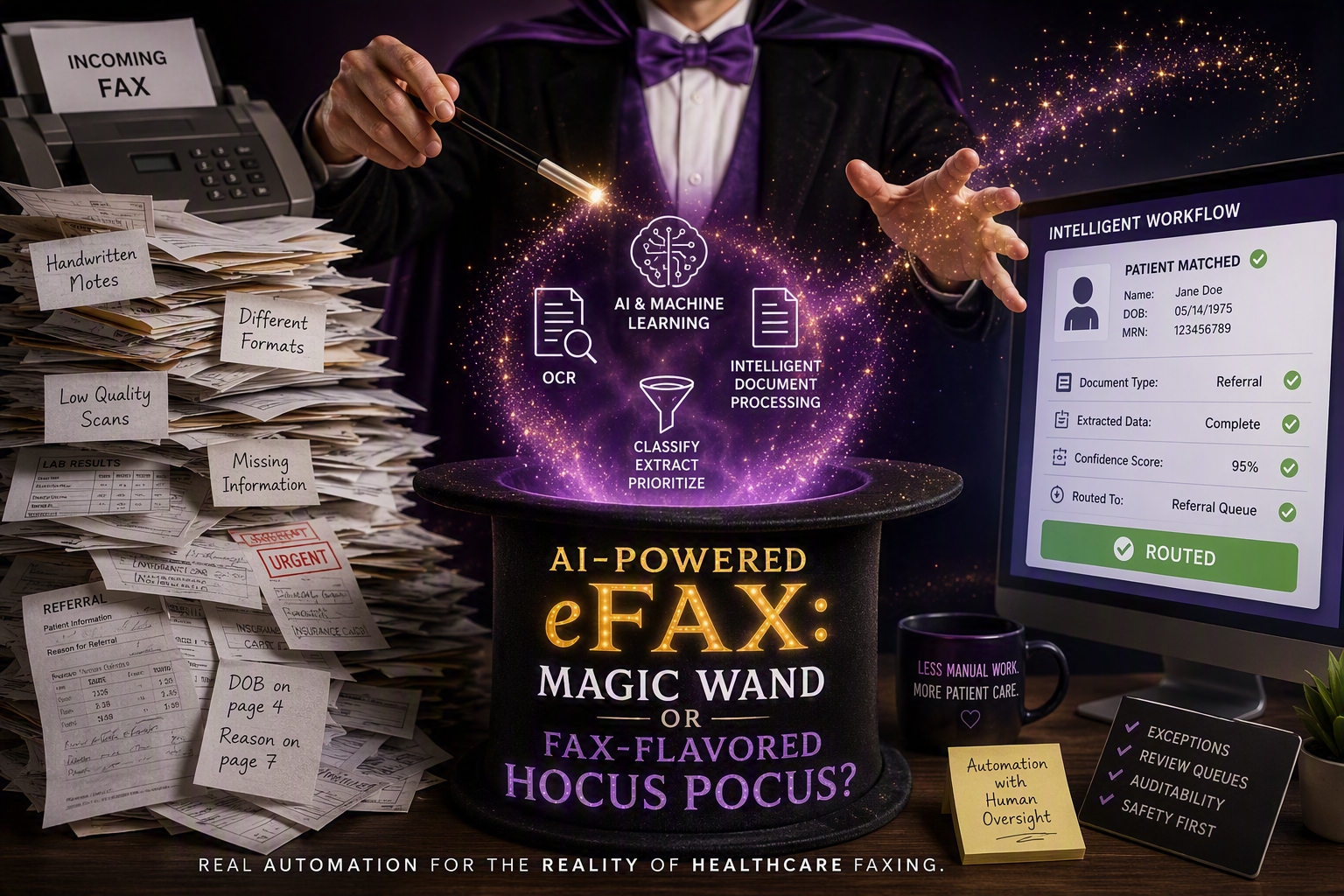
Why “intelligent fax automation” only works when the messy reality of healthcare faxing is handled first.
There is a lot of sparkle being sprinkled over faxing right now. Everywhere you look, eFax companies are promising AI-powered solutions that can read inbound documents, understand intent, extract clinical details, route information into the right workflow, and maybe—if the sales deck has enough animation—practically make coffee while they are at it.
And to be fair, some of the technology is impressive. OCR, natural language processing, intelligent document processing, and machine learning can absolutely reduce manual sorting, speed up intake, and help staff spend less time opening PDFs and retyping information. But there is a very important catch that often gets minimized in the magic show: these tools work best when the documents they receive are predictable, clean, and consistent.
Healthcare faxes are almost never predictable, clean, or consistent.
The Big Promise: AI Will Read the Fax So You Don’t Have To
The marketing message usually sounds something like this: send us your faxes, and our AI will classify them, extract the important data, match the patient, route the document, and turn your messy inbox into a tidy digital workflow. That sounds wonderful because everyone in healthcare knows the fax inbox is where productivity goes to quietly lose the will to live.
The problem is not the idea. The problem is the assumption hiding underneath it: that a fax is a stable, standardized input. In theory, AI can process structured information beautifully. In reality, healthcare faxes show up as scanned forms, referral packets, cover sheets, lab results, handwritten notes, rotated pages, duplicate attachments, low-resolution images, half-completed templates, and documents from every provider, payer, specialty office, hospital, lab, imaging center, and post-acute facility that has ever touched the patient.
That is not a magic-friendly environment. That is a junk drawer with PHI.
The Catch: Faxes Are Not Standardized
If every referral arrived on the same form, in the same format, from the same source, with the same required fields in the same locations, AI fax automation would have a much easier job. The system could learn the pattern, validate the data, and move documents through with confidence.
But that is not how healthcare works. One office sends a beautiful typed referral. Another sends a faxed fax of a scanned printout. Another adds a handwritten note in the margin. Another sends twenty pages when three would do. Another includes the patient name on page one, the date of birth on page four, and the actual reason for referral buried somewhere between an insurance card and a medication list.
AI can assist with that chaos, but it cannot magically make every fax behave like a clean electronic transaction. If the source documents are inconsistent, incomplete, or poorly labeled, the output still needs guardrails, exception handling, auditability, and human review.
When “AI-Powered” Becomes Hocus Pocus
The danger is not AI itself. The danger is overselling AI as a cure-all for broken workflows. If a vendor implies that their platform can fully automate inbound fax processing without asking hard questions about document types, source variability, patient matching rules, routing logic, data validation, and exceptions, that is when the smoke machine should start making you nervous.
Because in healthcare, a “pretty close” match is not good enough. Routing a referral to the wrong queue delays care. Attaching a document to the wrong patient creates risk. Missing an urgent note because it was handwritten, faint, or buried on page seven is not an automation success story. It is a liability wearing a wizard hat.
Real automation should be able to say, “I know what this is,” but it should also be able to say, “I am not sure, and a person needs to review it.” That second sentence is where responsible healthcare technology lives.
What Healthcare Organizations Should Ask Instead
Instead of asking whether an eFax vendor “has AI,” healthcare organizations should ask how the solution performs when the fax is messy, incomplete, duplicated, low quality, handwritten, or missing key information. Ask what confidence thresholds are used. Ask how exceptions are handled. Ask whether staff can see why a document was routed a certain way. Ask how patient matching is validated. Ask what happens when the system gets two possible matches. Ask whether the workflow improves over time without creating silent risk.
The best solutions do not pretend faxes are standardized. They are built for the fact that they are not. They combine automation with practical workflow design, clear routing rules, strong patient matching, review queues, reporting, and transparency. They reduce manual work without pretending humans can disappear from every step.
The Bottom Line
AI can absolutely make fax workflows smarter. It can help classify documents, extract information, prioritize work, and reduce the administrative burden that keeps healthcare teams buried in inboxes. But AI is not a magic wand, and fax is not a standardized data feed.
So when an eFax company promises something that sounds absolutely magical, it is worth asking whether the magic depends on every fax behaving perfectly. Because if the solution only works when every sender uses the same clean, standardized format, then it is not healthcare-ready. It is hocus pocus with a conference booth.