
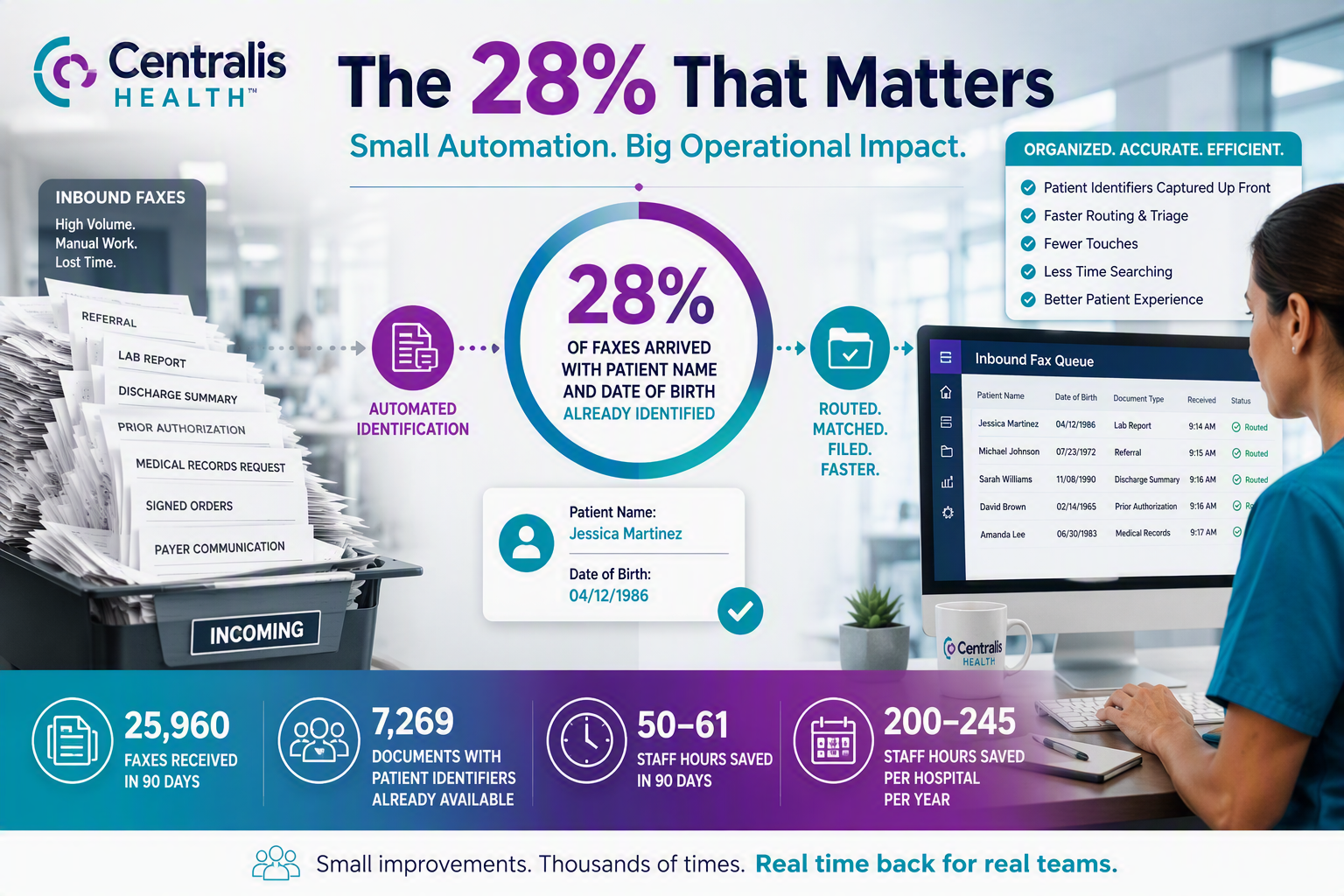
When patient name and date of birth arrive attached to a fax before staff even open the document, the savings may look small at first. At scale, they become hard to ignore.
Healthcare still runs on an enormous amount of faxed information. Referrals, lab reports, discharge summaries, prior authorizations, medical records requests, signed orders, and payer communications continue to arrive in fax queues every day. The problem is not only that these documents arrive by fax. The bigger operational burden is what happens next: someone has to open each document, identify the patient, confirm the date of birth, determine where it belongs, and route or file it correctly.
That is why a seemingly simple data point is worth a closer look: one hospital received 25,960 faxes over a 90-day period, and 28% of those faxes arrived with a patient name and date of birth already identified before a healthcare worker had to review the record.
At first glance, 28% may not sound transformational. It is not 80%, 90%, or full automation. But healthcare operations are rarely improved by one dramatic fix. More often, meaningful progress comes from removing small, repetitive steps that consume staff time hundreds or thousands of times.
What the Numbers Actually Mean
Twenty-eight percent of 25,960 faxes equals approximately 7,269 documents that arrived with the core patient identifiers already available. If it takes a staff member roughly 25 to 30 seconds to open a document and update it with the patient name and date of birth, that represents about 50 to 61 hours of staff time saved over 90 days.
Annualized, that same workflow improvement could save roughly 200 to 245 staff hours per hospital per year from this one narrow task alone. That is before considering downstream benefits such as faster routing, fewer duplicate touches, fewer naming inconsistencies, and less time spent searching for documents later.
Is That Helpful?
Yes. It is helpful because it removes a repeated administrative touch from thousands of documents. In a busy hospital environment, the value is not just measured in seconds. It is measured in fewer interruptions, cleaner queues, faster triage, and less cognitive load for staff who are already balancing competing priorities.
Healthcare teams do not need technology to replace every human decision to see value. Sometimes the win is much more practical: the record opens with enough information already present that the worker can move faster and focus on the items that truly require review.
Is It Impactful Enough to Benefit Healthcare?
Also yes, especially when the improvement is viewed as part of a larger workflow strategy. Inbound fax automation and document indexing are valuable because they reduce the manual work after the fax arrives: opening, reading, identifying, matching, filing, and routing. Industry discussions around fax automation consistently point to this post-arrival work as the real source of administrative burden, not merely the fax transmission itself.
For a single hospital, saving 50 to 61 hours in one quarter may be enough to reduce backlog pressure, support faster document turnaround, or free staff to focus on higher-value work. Across a health system with multiple hospitals, clinics, departments, or centralized intake teams, that same percentage becomes even more meaningful.
The impact is also cumulative. Patient identifiers are foundational to the rest of the workflow. When name and date of birth are available up front, staff have a stronger starting point for matching the document to the correct chart, routing it to the right queue, and avoiding preventable rework. That does not eliminate the need for verification, but it does reduce the amount of blank-slate investigation required for every fax.
The Bigger Point: Small Automations Add Up
A 25-second task does not feel significant when it happens once. But when it happens thousands of times, it becomes a staffing issue. It becomes a queue-management issue. It becomes a turnaround-time issue. And in healthcare, administrative delays can quickly create downstream frustration for patients, providers, and the teams responsible for keeping care moving.
The most practical healthcare technology does not always announce itself with a dramatic transformation. Sometimes it quietly removes one manual step from thousands of records. It helps busy teams work through queues faster. It gives staff better information at the moment they need it. It reduces repetitive data entry so people can spend more time on judgment, coordination, and follow-up.
Conclusion
So, is 28% helpful? Absolutely. Is it impactful enough to benefit healthcare? Yes, because impact in healthcare operations is often built one avoided click, one avoided search, and one avoided manual update at a time.
For this hospital, 7,269 faxes arriving with patient identifiers already available translated into roughly 50 to 61 hours of staff time saved in 90 days. That is real time back for a real team. And when multiplied across the full volume of healthcare documents moving through hospitals every day, it is exactly the kind of practical improvement that makes healthcare work better.