
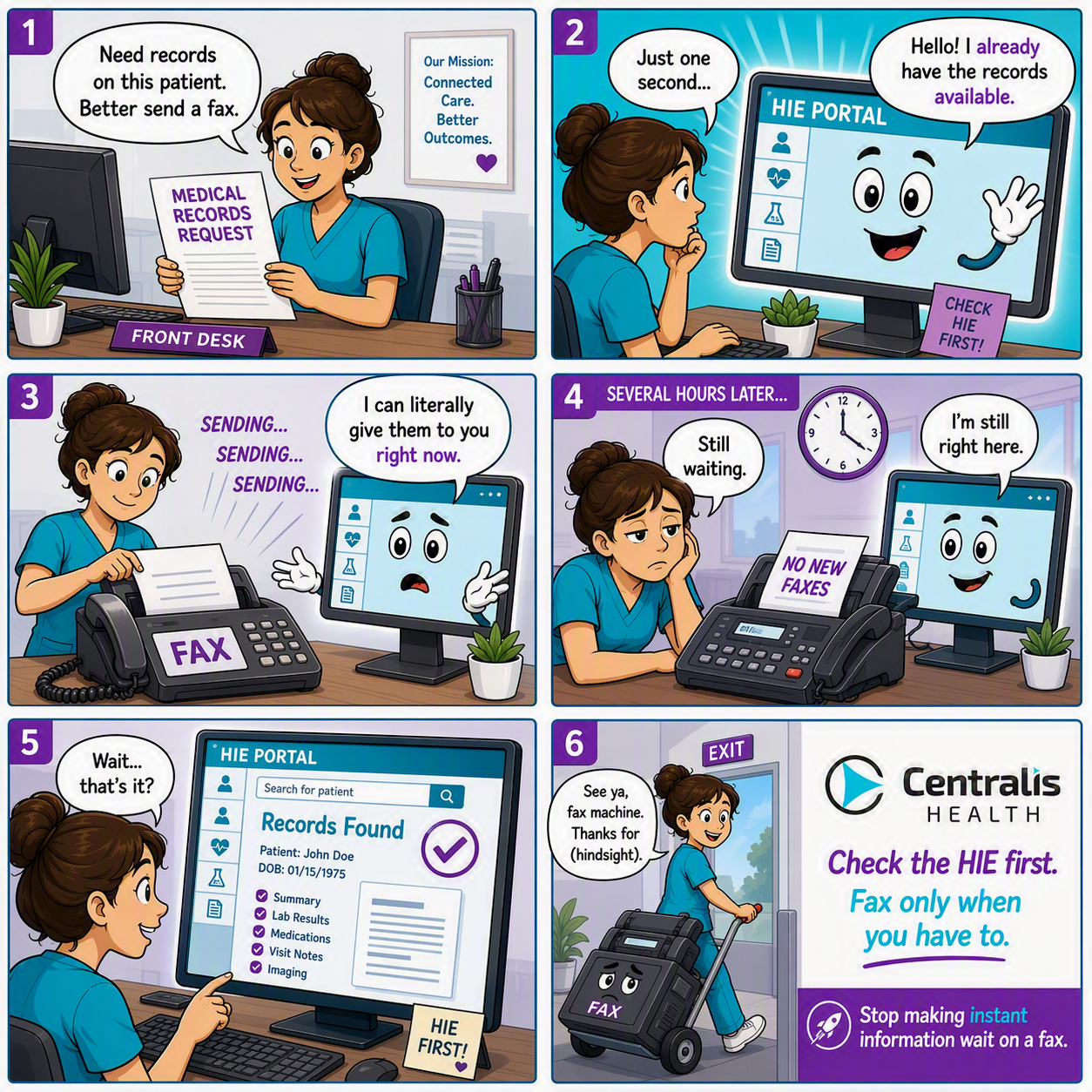
The records may already be available in seconds—yet too many requests still take the slow lane.
At Centralis Health, there is a particular kind of frustration we feel when we see a participant faxing a medical records request for information that may already be available through the Health Information Exchange (HIE). The organization has access. The connection is in place. The record could potentially be found almost instantly. And yet, someone is still feeding a request into a fax workflow and waiting for a response.
This is not frustration with the people doing the work. Healthcare teams are busy, under pressure, and often following processes they inherited years ago. Our frustration is with a system that gives people access to a faster path but does not always help them build the habit, confidence, or workflow to use it.
The Fax Reflex Is Still Strong
Faxing is familiar. Staff know which form to use, which number to send it to, and which work queue to check later. In many organizations, “send a records request” automatically means “send a fax,” even when an HIE is available. Familiarity can make an outdated process feel easier than a better one.
But the familiar route comes with delays: preparing the request, confirming the fax number, transmitting it, waiting for the receiving organization to process it, monitoring for a response, and following up when nothing arrives. If the request is incomplete, unreadable, misrouted, or sent to the wrong number, the cycle starts again.
The Record May Already Be There
With an HIE, an authorized user can search for the patient, locate available clinical information, and retrieve what is needed without asking another organization to stop its work and respond manually. What might take hours—or days—through fax can sometimes be completed in moments.
Of course, not every record from every source will always be available, and access must follow organizational policy, patient authorization requirements, and applicable privacy rules. But the HIE should be the first place to look—not the last resort after a fax has already been sent.
What Changes When Teams Check the HIE First
- Faster access to information: Clinicians and staff can retrieve available records while the patient is still in front of them.
- Less administrative work: Teams spend less time preparing requests, checking fax queues, making follow-up calls, and scanning returned documents.
- Better-informed care: More timely information can support medication reconciliation, treatment decisions, referrals, and transitions of care.
- Fewer avoidable delays: Care does not have to pause simply because another office has not yet processed a fax.
- More value from existing technology: Organizations get the benefit of an HIE connection they already have instead of maintaining unnecessary manual work.
Access Alone Is Not Adoption
Providing access is only the beginning. If organizations want staff to use the HIE consistently, the preferred workflow must be clear: check the HIE first, send a fax only when the needed information is not available, and document the exception when appropriate. Training should use real-world scenarios, reinforce how to locate records efficiently, and give staff a simple path for help when a search does not return the expected result.
Leaders can also review where medical records requests originate, identify teams that continue to rely heavily on fax, and ask a straightforward question: Could this request have been fulfilled through the HIE? The goal is not to blame staff. It is to remove uncertainty, adjust the workflow, and make the fastest appropriate option the easiest one to choose.
Let’s Stop Making Instant Information Wait on a Fax
At Centralis Health, we want our participants to get the full value of connected healthcare. When a record is available through the HIE, retrieving it should not require paper, phone calls, repeated follow-up, or crossed fingers next to a fax machine. It should require a secure search and a few clicks.
If your team has HIE access but still defaults to fax, let’s talk. Centralis Health can help identify workflow gaps, reinforce HIE-first practices, and make it easier for staff to retrieve the information they need when they need it.