
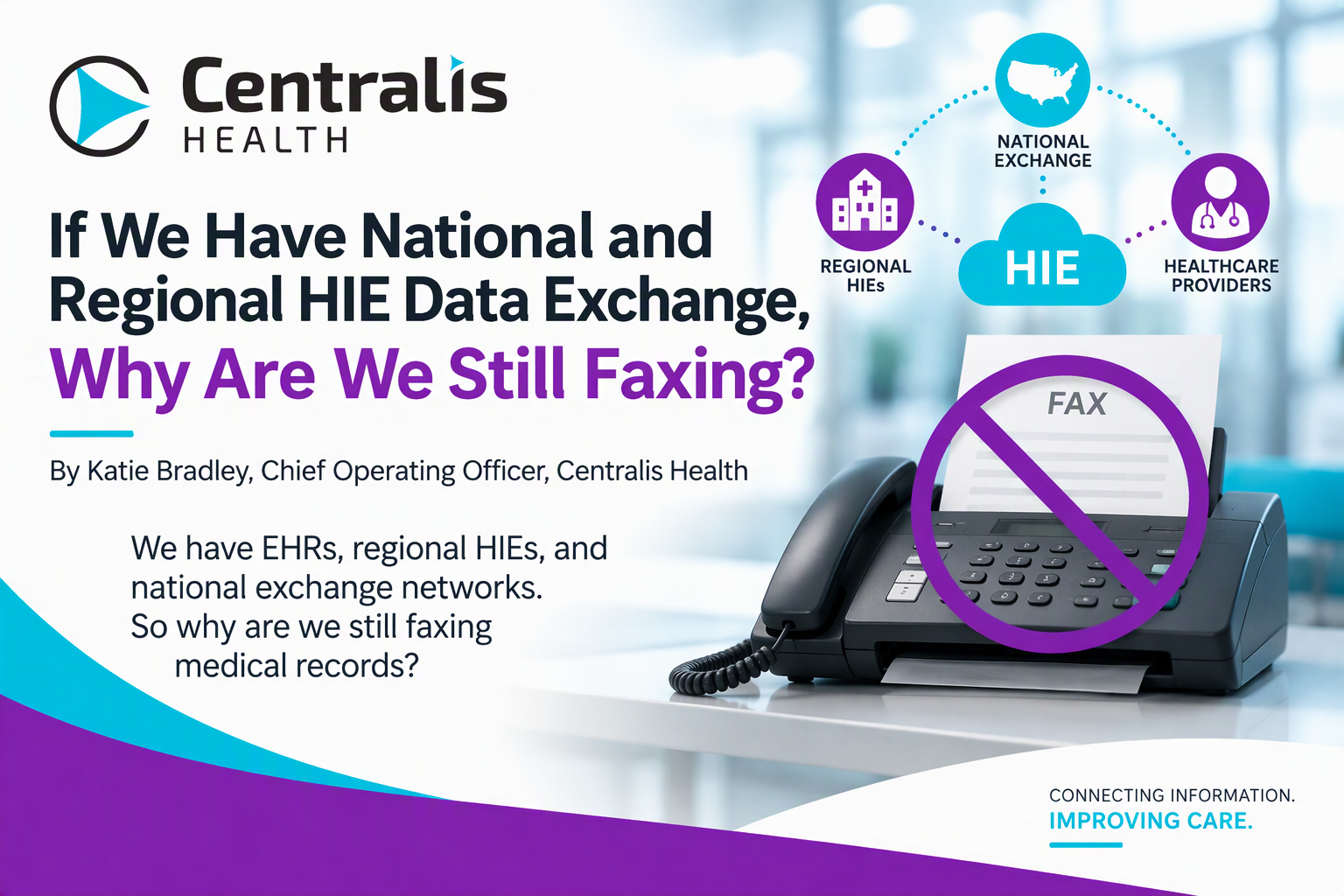
If We Have National and Regional HIE Data Exchange, Why Are We Still Faxing?
By Katie Bradley, Chief Operating Officer, Centralis Health
It is a question I keep coming back to:
If healthcare has invested so much in interoperability, national networks, regional HIEs, and electronic exchange, why are we still faxing medical records?
We have EHRs talking to EHRs. We have regional Health Information Exchanges. We have national exchange networks. We have increasingly sophisticated ways to identify patients and move clinical information between organizations.
And yet, somewhere right now, someone is still faxing 47 pages of medical records to another provider.
Why?
The answer, in my opinion, is not that electronic exchange does not work.
The problem is that what is being exchanged electronically is not always what the provider actually needs.
We Are Exchanging Data. But Are We Exchanging the Record?
Many healthcare organizations rely heavily on the interoperability functionality built into their EHR.
And why wouldn’t they?
In many cases, it is already there. There may be no separate HIE portal to access, no additional workflow for staff to learn, and sometimes it is perceived as essentially “free” because the capability is bundled into the EHR ecosystem.
The result can be a pretty impressive electronic summary of the patient.
You may get information such as:
- Allergies
- Medications
- Problems
- Vital signs
- Laboratory results
- Past medical history
- Procedures
- Immunizations
- Associated providers
- Encounter information
- Other structured clinical data
That information can be incredibly valuable.
But there is a difference between having data about the patient and having the clinical documentation that tells the patient’s story.
That distinction matters.
Bringing clinical data from different EHRs together into a longitudinal patient record is an important step toward giving providers a fuller picture at the point of care. But gathering data is only part of the goal. Providers also need the clinical documentation and context that explain what happened, why decisions were made, and what comes next.
Where Are the Notes?
This is where I think the interoperability conversation gets interesting.
If I am a provider seeing a new patient, knowing their medications, allergies, diagnoses, and recent labs is important.
But I also want to know:
What did the last provider actually say?
Where is the note that says:
“I saw the patient today. They report…”
What did the patient complain about?
What did the physician observe?
What was discussed?
What did the provider think was happening?
What did they recommend?
What procedure was actually performed?
What were the findings?
What did the specialist tell the patient to do next?
Those details often live in the progress note, consultation note, procedure note, operative report, discharge documentation, imaging narrative, or other clinical documentation.
That is the meat and potatoes of the medical record.
And when that documentation is not readily available through the electronic exchange workflow, what happens?
Someone asks for the records.
And very often, that means a fax.
Maybe That Is Why Fax Refuses to Die
Healthcare does not continue faxing because everyone loves fax machines.
We fax because, when the electronic data available to a clinician does not answer the clinical question, somebody still needs the rest of the record.
The specialist’s note.
The procedure report.
The hospital documentation.
The actual narrative explaining why a diagnosis was made or why treatment changed.
Our existing Faxing and HIE makes the operational consequence very real: an incomplete record can mean staff requesting records again, waiting again, and potentially even rescheduling a patient’s appointment.
So perhaps the more important interoperability question is no longer:
“Can we exchange patient data?”
We clearly can.
The better question may be:
“Can the provider get the information they actually need to care for this patient without picking up the phone or sending another fax?”
That is a much higher bar.
A CCDA Is Valuable, but It Is Not Necessarily the Whole Story
Structured clinical documents such as CCDAs solved an important problem. They allow health systems to exchange standardized clinical information rather than sending everything as an unstructured document.
But healthcare runs on more than discrete data elements.
It runs on context.
A diagnosis code tells me the patient has back pain.
The provider’s note tells me the patient has had worsening lower back pain for six weeks, that it radiates down the left leg, that conservative treatment has failed, and that an MRI was ordered because the provider suspects a herniated disc.
Those are two very different levels of information.
Both have value.
But if I am the next provider responsible for that patient’s care, I probably want the second one.
“Free” Exchange Can Still Have a Cost
This is also where the economics get tricky.
Health systems and practices may understandably ask:
“Why should we pay for another connection or HIE when our EHR already exchanges information?”
That is a fair question.
But the cost of interoperability should not be measured solely by the price of the connection.
We also have to look at what happens after the exchange fails to deliver enough information.
If staff still have to:
- Search the EHR for outside records.
- Determine something is missing.
- Call another practice.
- Submit a records request.
- Send a fax.
- Monitor for the response.
- Sort through the incoming pages.
- Attach or index them to the correct patient.
- Route the documentation to the provider.
Then the exchange may have been financially “free,” but the workflow certainly wasn’t.
There is a labor cost.
There is a time cost.
There is an opportunity cost.
And sometimes there is a patient-care cost.
Local, Regional and National Exchange All Have a Role
I do not believe this is an either/or conversation.
National exchange is incredibly valuable, particularly when a patient receives care outside their normal healthcare community.
Regional HIEs can add another layer by bringing together richer information from the hospitals, specialists, post-acute facilities, practices, and other organizations that routinely care for the same patient population.
Direct interfaces can provide still another level of depth.
Even in our discussions about national exchange, we have challenged ourselves with the same question: if a facility is already exchanging nationally, why does a direct connection still matter? That distinction between broad national availability and richer local/direct data is a challenge we are actively thinking about at Centralis.
The goal should not be choosing one network and declaring interoperability solved.
The goal should be:
Get the clinician the most complete, clinically useful information possible, through the simplest workflow possible.
The Real Test of Interoperability
Maybe we have been measuring interoperability the wrong way.
Connected does not automatically mean complete.
Exchanged does not automatically mean useful.
And a list of medications, allergies, vitals, labs, and diagnoses does not always tell a provider what happened during the patient’s last encounter.
So the next time someone asks:
“If all this healthcare data is being exchanged electronically, why are we still faxing?”
My answer is simple:
Because sometimes we are exchanging the data, but we are still faxing the story.
Until electronic exchange consistently gives providers both, healthcare is going to continue filling those gaps using the tool it has relied on for decades.
Unfortunately, that tool is still the fax machine.
The Opportunity
The answer is not to abandon national exchange, regional HIEs, EHR interoperability, or structured data.
It is to make them better.
We need an interoperability strategy that combines the scale of national exchange with the depth of regional and direct clinical connections, giving providers access not only to the patient’s data points, but to the documentation and context behind them.
Because the ultimate measure of interoperability should not be how much data we exchange.
It should be:
Did the provider get what they needed to care for the patient?
And if the answer is still, “Not until the fax arrived,” then we still have work to do.
Do Not Take Our Word for It. Ask to See the Records.
Do not blindly trust any organization to share records on your behalf—even if that organization is Centralis Health. Ask your exchange partner to show you exactly what is being shared across multiple patients, not just one carefully chosen example. Verify that the records are full and complete, including the clinical documentation and context your providers need—not just a summary of data points.
If something is missing, you have every right to ask why. What is not being shared? Why is it missing? And what needs to change to close the gap?
Put yourself in the receiving provider’s shoes: would the information you are sharing be useful at their next patient appointment? Would it help them understand what happened and what to do next? If the answer is no, you know there is still work to do.
You are the customer. Ask for more than assurances that your organization is connected. Ask to see whether the records being shared actually give your providers what they need to care for their patients.