
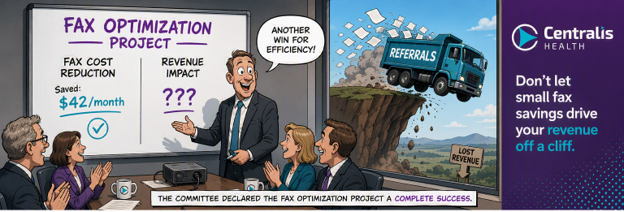
Cheap faxing looks like savings on paper. In reality, it may be quietly slowing down referrals, delaying care, frustrating staff, and leaking revenue.
Healthcare leaders will scrutinize the cost of a fax line, argue over a few cents per page, and shop for the cheapest solution they can find. But here is the uncomfortable question: why do we treat faxing like a disposable utility when it is often carrying some of the most financially important communication in the organization?
Referrals, prior authorizations, medical records, orders, payer correspondence, billing documentation, and care transition packets still move through fax every day. These are not casual messages. They are the documents that determine whether a patient gets scheduled, whether a service is approved, whether a claim gets paid, and whether revenue moves forward or gets stuck in the mud.
And yet, many healthcare organizations still approach faxing with a “free or cheap is good enough” mindset.
The Fax Is Not the Problem. The Workflow Around It Is.
Fax has survived in healthcare for one simple reason: it works across organizations that do not share the same technology. A small primary care office, a hospital, a payer, a specialty group, a skilled nursing facility, and an independent lab may all use different systems, portals, and processes. Fax remains the common bridge between them.
But the value of fax is not in the transmission alone. The real value is in what happens after the document arrives.
Was the referral received? Was it matched to the correct patient? Was it routed to the right team? Was it entered into the EHR? Was the patient contacted? Was the authorization started? Was the appointment scheduled? Was the loop closed with the referring provider?
If the answer to any of those questions is “we think so,” then the organization does not have a fax problem. It has a revenue visibility problem.
Cheap Faxing Creates Expensive Blind Spots
The problem with bargain faxing is that it often measures success at the wrong point. Did the fax send? Did the page transmit? Did the system show a confirmation?
Those are not the same as knowing whether the document was received, understood, assigned, acted on, and converted into care.
A low-cost fax solution may be technically “working” while referrals sit in a shared inbox, prior authorization paperwork waits for manual review, orders get misfiled, and staff spend hours chasing confirmations. The invoice may look small, but the downstream cost can be enormous.
In healthcare, the cheapest communication channel can become one of the most expensive operational decisions when it slows the path from referral to scheduled visit, from authorization to service, or from documentation to reimbursement.
Fax Carries Revenue-Critical Work
Think about the types of documents that commonly arrive by fax:
- New patient referrals
- Specialty consult requests
- Prior authorization forms
- Insurance correspondence
- Medical records needed for billing or appeals
- Orders for imaging, labs, home health, hospice, or post-acute care
- Discharge summaries and care transition documents
- Clinical documentation needed to support claims
Each one of those documents can represent a patient, a service, a claim, a reimbursement event, or a relationship with a referring provider. When the fax workflow breaks down, the impact is rarely isolated to “paperwork.” It can mean lost appointments, preventable denials, avoidable write-offs, delayed cash flow, duplicated staff work, and frustrated patients who go somewhere else.
For hospitals and medical groups, referral leakage alone can be financially significant. Industry research has described missed referral appointments as costing hospitals hundreds of thousands of dollars per physician per year, and only a portion of faxed referrals reliably turning into scheduled appointments. That is not a fax cost issue. That is a revenue capture issue.
The “Free Fax” Mindset Ignores the Cost of Human Work
Free faxing is never truly free if a person has to babysit it.
If staff must open every document, read every page, determine the document type, identify the patient, check whether key information is missing, rename the file, upload it, route it, call to confirm receipt, and manually follow up, then the organization is not saving money. It is shifting the cost from technology to people.
And healthcare staff are already stretched thin. Every minute spent sorting faxes is a minute not spent scheduling patients, closing gaps in care, resolving denials, supporting providers, or helping patients navigate next steps.
The real question is not, “How little can we pay for fax?” The better question is, “How much revenue, time, and trust are we losing because the fax workflow is still manual?”
Modern Faxing Should Create Accountability
Healthcare does not necessarily need to eliminate fax overnight. That is not realistic for many organizations, especially when payers, independent practices, and community partners still rely on it. But healthcare does need to stop treating fax as a passive inbox.
A better fax strategy should help answer questions like:
- What came in?
- Who sent it?
- What type of document is it?
- Which patient does it belong to?
- Where should it go?
- Has anyone acted on it?
- Is anything missing?
- How long has it been waiting?
- Did it result in a scheduled visit, completed authorization, or billed service?
That is where fax becomes more than a transmission tool. It becomes part of operational intelligence.
Stop Measuring Fax by the Page. Start Measuring It by the Outcome.
If fax is moving referrals, authorizations, records, and billing documentation, then it deserves the same strategic attention as other revenue cycle workflows. Healthcare organizations should be asking:
- How many inbound faxes represent potential revenue?
- How many referrals are never scheduled?
- How many authorizations are delayed because documents are incomplete or misrouted?
- How much staff time is spent manually processing faxes?
- How many denials or write-offs are tied to missing documentation?
- How often do referring providers call to ask, “Did you get my fax?”
When those answers are unknown, the organization is flying blind in a workflow that may be directly tied to patient access and reimbursement.
The Bottom Line
Healthcare cannot afford to treat fax like an afterthought while depending on it to carry the documents that drive care, claims, approvals, and revenue.
Cutting corners on faxing may feel like a harmless budget decision, but the hidden cost shows up elsewhere: in staff burnout, delayed care, referral leakage, payer follow-up, denials, lost visibility, and missed revenue opportunities.
If fax is still part of the way healthcare does business, then it should be managed like a business-critical workflow. Not because anyone loves fax. Not because fax is the future. But because, for many organizations, fax is still carrying the revenue.
Call to action: Before choosing the cheapest fax option, look at what your fax workflow is actually carrying. If it includes referrals, authorizations, records, and documentation needed for payment, it may be time to stop asking what fax costs and start asking what poor fax management is costing you.