
Why a Health Information Exchange Keeps Writing About Faxing
If you have followed Centralis Health for any length of time, you may have noticed something: we talk about faxing a lot.
And yes, we know. For a health information exchange, faxing may seem like an odd topic to keep coming back to. Shouldn’t we be talking only about interoperability, national networks, secure data exchange, patient matching, clinical documents, and the future of connected healthcare?
We do talk about those things. But we also keep talking about faxing because faxing is still one of the clearest signs that interoperability is not finished yet.
In healthcare, faxing is not just an outdated habit. It is often the fallback when systems do not connect, when outside records are hard to locate, when a portal is too limited, or when a workflow still depends on someone manually pushing information from one organization to another. It is the workaround that keeps care moving when technology has not fully caught up with real-world operations.
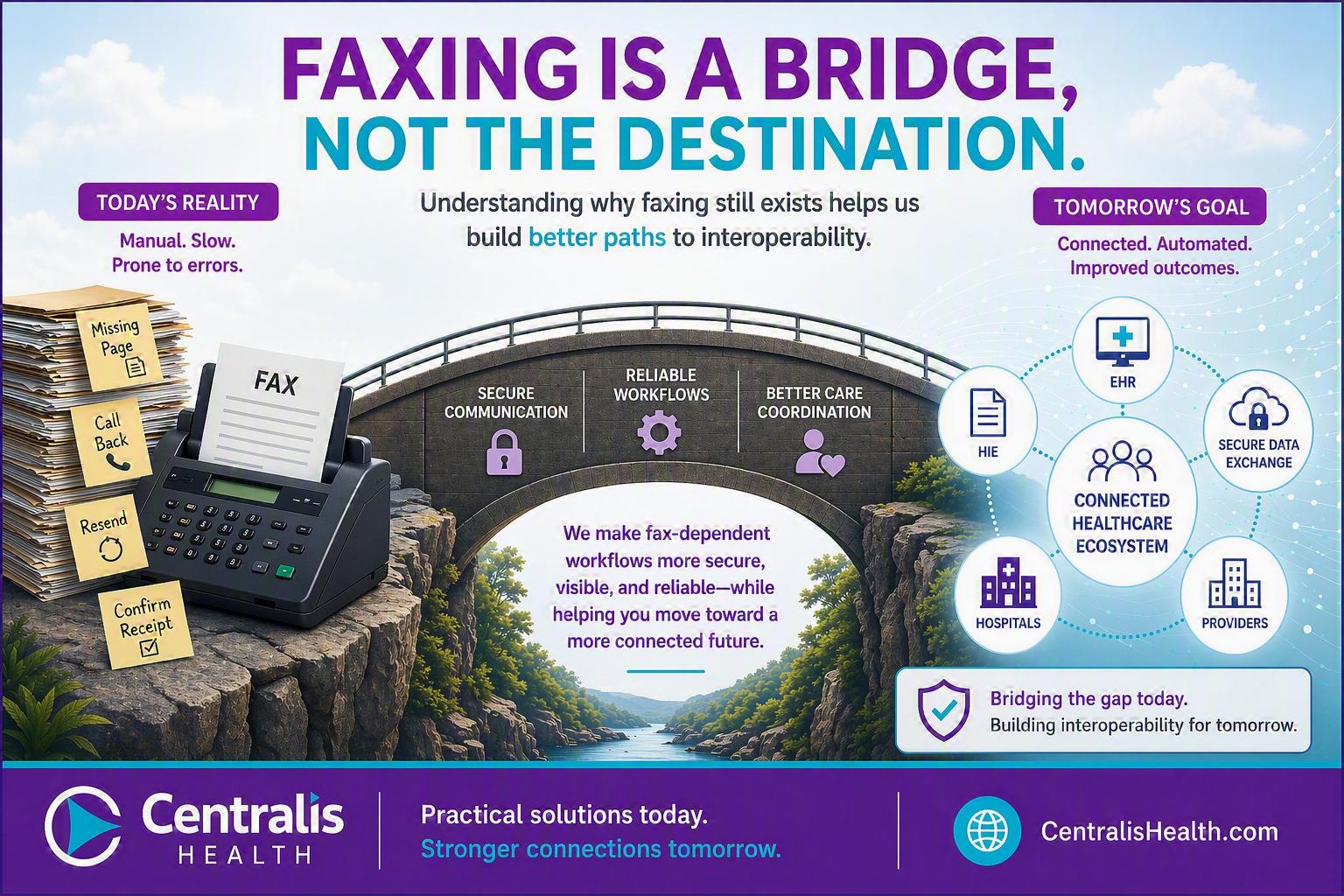
Faxing Is a Bridge, Not the Destination
At Centralis Health, our long-term goal is not to make healthcare more dependent on faxing. Our goal is to help healthcare organizations move toward better, more reliable, more useful exchange of information.
But we also live in the real world. Healthcare organizations still receive referrals, records, orders, authorizations, and clinical documents by fax every day. Even organizations that are connected to modern exchange networks may still need a secure way to communicate with partners who are not fully connected, are not connected in the right workflow, or are not able to exchange information electronically in the moment it is needed.
That is why Centralis Health provides HIPAA-compliant faxing solutions as part of a broader interoperability strategy. Faxing is not the future we are building toward, but it is one of the bridges many healthcare teams still need today.
A bridge matters when the gap is real. And in healthcare, the interoperability gap is still very real.
Why Faxing Still Deserves Attention
It is easy to make faxing the punchline. But for the people working inside healthcare workflows, faxing is not funny when the referral never arrives, the records come through incomplete, the receiving number is wrong, or a patient has to wait longer because the information needed for care is stuck in a manual process.
Those little failures add up. A missing page can become another phone call. A failed transmission can become another delay. A hard-to-read document can become another staff member trying to interpret, rename, route, scan, upload, or re-send something that should have moved cleanly the first time.
That is why we pay attention to the details. Better faxing is not about celebrating fax technology. It is about reducing avoidable friction while healthcare continues transitioning toward more connected exchange.
Katie Bradley’s Fax Obsession Has a Purpose
Our Chief Operating Officer, Katie Bradley, has a bit of a reputation around here for being obsessed with faxing. Not because she loves fax machines. Quite the opposite.
Katie’s focus comes from years of seeing how small communication breakdowns create real operational consequences. Before leading operations at Centralis Health, she worked in the kind of healthcare environments where referral coordinators, nurses, office managers, and front desk teams had to chase records, confirm receipt, re-send documents, and explain delays to patients.
That experience shaped the way she looks at interoperability. Big technology matters, but so do the small workflow adjustments that make information more reliable, visible, and usable. Sometimes the fix is a better exchange connection. Sometimes it is a smarter routing process. Sometimes it is more complete patient matching. Sometimes it is simply making sure a fax-dependent workflow is not being treated like an afterthought.
That is the heart of the obsession: finding the small adjustments that make healthcare communication more reliable and sustainable while continuing to move organizations toward stronger interoperability.
HIPAA-Compliant Faxing Still Has a Role
Centralis Health provides HIPAA-compliant faxing because healthcare teams still need secure, manageable ways to communicate with organizations that are not yet fully connected through modern exchange. But our approach is not to leave faxing isolated from the rest of the workflow.
When faxing is connected to a broader health information exchange strategy, it becomes easier for healthcare teams to track documents, reduce manual follow-up, and manage information more securely.
That matters because interoperability is not only about whether data can technically move from one system to another. It is about whether the right information reaches the right person in a way that supports care, operations, compliance, and accountability.
Faxing Shows Us Where Interoperability Still Needs Work
We keep writing about faxing because it helps make interoperability practical. Everyone in healthcare understands what it feels like to wait on records, re-send a document, search for a missing page, or call to confirm whether something arrived.
Those moments reveal where systems are still disconnected. They show where workflows are still too manual. They show where staff are carrying the burden of incomplete technology. And they show where patients may experience the consequences of delays they never see.
At Centralis Health, we believe healthcare organizations need both: the ability to move beyond fax where stronger exchange is possible, and the ability to make fax-dependent workflows safer, more reliable, and easier to manage where faxing still exists.
So yes, we will probably keep writing about faxing.
Not because faxing is the future of healthcare communication, but because understanding why faxing still exists helps us build better bridges to the future. And until every healthcare organization can exchange the right information at the right time, in the right workflow, we are going to keep paying attention to the workarounds that still hold healthcare together.