
Electronic Health Records (EHRs) have transformed healthcare by centralizing patient information, improving documentation, and supporting clinical decision-making. But despite their many capabilities, one misconception continues to create inefficiencies across healthcare organizations:
Your EHR is not your communication system.
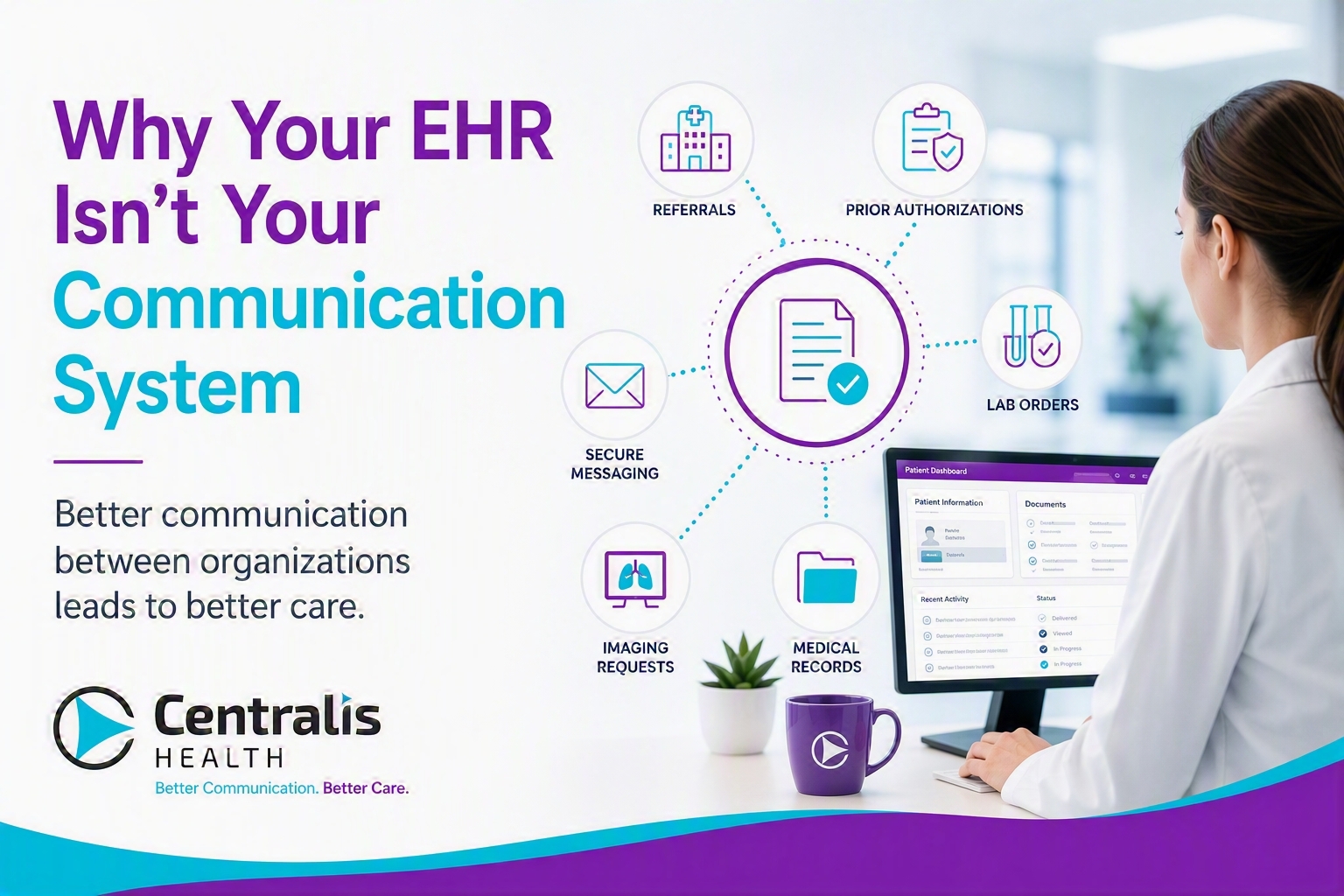
While your EHR excels at managing patient records, much of the communication required to coordinate care still happens outside of it. Referrals, medical records, prior authorizations, lab orders, imaging requests, and countless other documents continue to move between organizations through a variety of channels—including fax, secure messaging, health information exchanges (HIEs), and email.
Understanding this distinction is the first step toward improving care coordination.
The EHR Stores Information
Think of your EHR as the central repository for patient data. It is designed to document care, manage encounters, store clinical information, and support providers while they are treating patients.
It answers questions like:
- What medications is the patient taking?
- What were the lab results?
- When was the last office visit?
- What diagnoses are documented?
This information is essential—but only after it has successfully reached your organization.
Communication Happens Between Organizations
Healthcare communication begins long before information appears in the patient’s chart.
Consider a typical referral:
- A primary care provider identifies the need for a specialist.
- Referral documents are prepared.
- Clinical notes are sent.
- Insurance information is included.
- The receiving office acknowledges receipt.
- The patient is scheduled.
- Consultation notes are returned to the referring provider.
At every step, information is exchanged between different people, different organizations, and often different EHR systems.
That’s where communication platforms become critical.
In fact, many EHRs already rely on third-party vendors to support faxing and document delivery. If that workflow is going to depend on an outside vendor, why not choose one that is built around healthcare communication? Centralis understands the importance of reliable delivery, clear visibility, and timely follow-up because we know these documents are not just paperwork—they are part of the patient care journey.
Interoperability Doesn’t Eliminate Communication Challenges
Healthcare has made tremendous progress toward interoperability, but not every organization uses the same EHR. Even when systems can exchange data electronically, referrals often require supporting documentation, signed forms, insurance information, or images that must be shared through additional communication channels.
Successful care coordination depends on more than simply having interoperable systems—it depends on ensuring information reaches the right person, at the right time, with visibility into its status.
Visibility Matters
One of the biggest challenges healthcare organizations face isn’t sending information—it’s knowing what happened after it was sent.
Questions such as:
- Was the referral successfully delivered?
- Did the receiving office receive all of the pages?
- Has anyone viewed or processed the referral?
- Is additional documentation needed?
- Has the patient been scheduled?
Without visibility into these steps, staff often spend valuable time making phone calls, resending documents, and manually following up.
These manual processes increase administrative burden and delay patient care.
Better Communication Creates Better Workflows
Improving healthcare communication isn’t about replacing your EHR—it’s about extending its capabilities.
Organizations that invest in modern communication workflows gain:
- Greater visibility into referrals and document delivery
- Fewer duplicate transmissions
- Improved staff productivity
- Better accountability through audit trails
- Actionable reporting and analytics
- Faster coordination between care teams
Rather than working around communication gaps, staff can focus on what matters most: caring for patients.
The Bottom Line
Your EHR is one of the most important systems in your organization—but it was never designed to manage every aspect of healthcare communication.
As healthcare becomes increasingly connected, organizations need communication tools that complement the EHR by providing visibility, accountability, and streamlined workflows across the entire continuum of care. Centralis already has existing interfaces with many EHR systems, and if there is an interface we have not built yet, we are always willing to have that conversation.
Because better communication doesn’t just improve operations—it improves patient care.